
Learning from the B-1B Crash: Insights for Corporate Teams
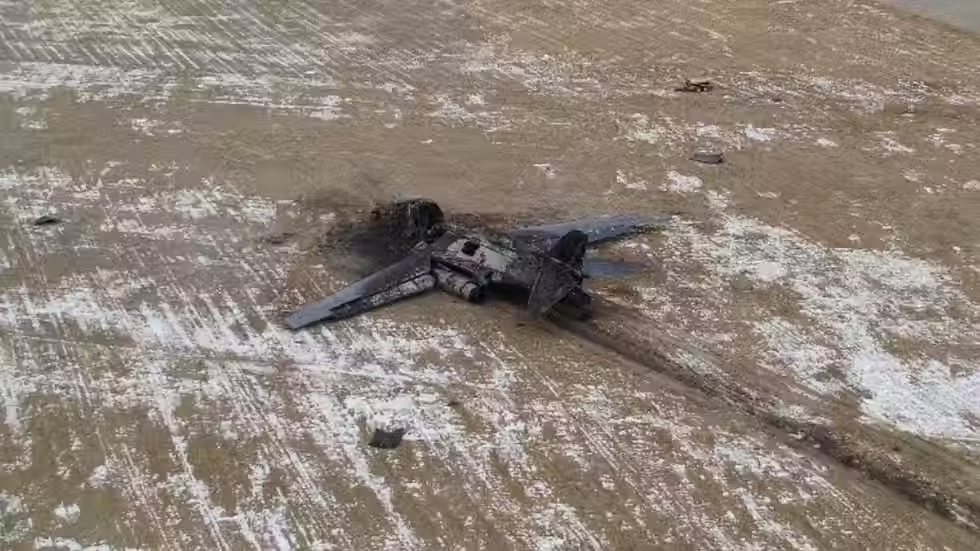
On 4 January 2024, a USAF bomber was destroyed during operations at Ellsworth Air Force Base. There was no hostile action, no mechanical failure in the traditional sense, and no dramatic chain of obvious errors.
Instead, the Accident Investigation Board (AIB) describes a sequence of events shaped by crosschecking breakdowns, ineffective crew coordination, supervision gaps, and challenging environmental conditions. This culminated in an outcome that, with hindsight, now appears inevitable.
The report is detailed, methodical, and authoritative. Yet, as a learning tool, it falls a long way short in my opinion. Not because the findings are wrong, but because they don't really help us learn. The lens through which the accident is examined is clouded by hindsight bias, heavy use of counterfactuals (“could have”, “should have”, “failed to”), and conclusions that stop just as the most useful questions begin.
This matters because if investigations don’t help us understand why normal people did normal things in a normal system, then recurrence prevention remains theoretical.
What Happened (In Simple Terms)
The AIB describes an operation conducted in degraded weather conditions, including undetected windshear. Crews were operating in a complex airfield environment under supervision that was itself stretched across multiple responsibilities.
During the sequence of events, the aircraft’s energy state and flight path were not effectively monitored or challenged. Crosschecks did not catch developing problems. Crew coordination degraded. Supervisory oversight failed to identify emerging risks. Environmental threats were present but not salient.
After the accident, all of this is obvious. Before it, nothing apparently was, and that distinction is critical.
The Problem with “Lessons” Framed by Hindsight
The report repeatedly uses language such as:
failed to
did not
should have
could have
These statements may be factually accurate, but they are analytically shallow. They tell us what didn’t happen, not why it made sense at the time for those involved to do what they did. This is far more useful if we want to know what to change.
As a result, the report risks reinforcing a dangerous illusion: that if people simply complied harder, paid more attention, or followed the rules better, the accident would not have occurred. History tells us that this is rarely true.
“The Accident Was Caused by a Lack of an Effective Crosscheck by the Pilot”
This conclusion appears clear, decisive, and unsatisfying. Yes, the crosscheck did not catch the developing problem. But why?
The report does not meaningfully explore:
How easy or difficult was it to crosscheck the relevant instruments in those conditions?
How salient were the cues in real time?
What simulator training did crews receive to recognise subtle energy-state deviations?
Did previous training emphasise expectation-driven monitoring over active challenge?
Crosschecking is often treated as a personal discipline, when in reality it is a system-supported behaviour. If the aircraft state does not “look wrong”, if expectations say things are normal, if workload is high and cues are weak, humans will miss things. That is not negligence; it is cognition. It is completely normal behaviour!
Better learning question: How can systems, training, and interfaces make meaningful crosschecks easier and missed crosschecks harder?
“The Crew Failed to Perform Standard Crew Resource Management”
CRM is meant to help crews manage complexity, not become another standard they are judged against after the fact. Saying the crew “failed to perform CRM” raises far more questions than it answers:
What specifically broke down? Communication, assertiveness, task sharing, challenge?
Do these breakdowns happen often with no consequence?
Was the crew operating under time pressure or task saturation?
Were authority gradients at play?
Did the environment reward smooth execution over active questioning?
CRM failures are rarely conscious decisions to abandon teamwork. They usually emerge when workload, expectation, and culture quietly squeeze it out. If CRM didn’t happen, the most useful question is not why didn’t they do it, but what made it hard to do at that moment.
Better learning question: What conditions eroded the crew’s ability to use CRM when they needed it most?
“Ineffective Flying Operations Supervision”
This is one of the most important and least explored findings in the report. The supervisor:
Was performing two roles simultaneously.
Had limited awareness of the airfield environment.
Was unaware of an active NOTAM.
But the report stops short of asking the obvious follow-on questions:
Is dual-role supervision normal due to manpower constraints?
Has task saturation in supervisory roles been raised before?
How are supervisors expected to maintain environmental awareness?
How many NOTAMs were active, and how distinguishable was the critical one?
NOTAM fatigue is a known, well-documented problem. When everything looks important, nothing is. If supervision failed, it may not be because the individual supervisor was ineffective, but more because the system made effectiveness unrealistic.
Better learning question: What did the system assume this supervisor could reasonably keep track of, and was that assumption valid?
Adverse Weather and Undetected Windshear
The report identifies windshear as a contributing factor, while also noting that it was undetected. This matters. Humans are poor at detecting threats they are not expecting, especially when:
Cues are subtle.
Workload is high.
Attention is already committed elsewhere.
Modern airliners use automated windshear detection and audio warnings precisely because humans cannot reliably detect these conditions in time. Those systems were not available here. The report acknowledges the environmental conditions, but does not meaningfully explore:
How could windshear awareness be improved?
What technological mitigations might exist?
How might future crews be better alerted before it becomes critical?
Better learning question: If humans are bad at detecting windshear, how do we make it obvious or remove the need for detection altogether?
Culture, Leadership, and the Illusion of Obviousness
The report references broader cultural and leadership issues. With hindsight, patterns become visible. But it is highly unlikely that anyone involved believed things were unsafe before the accident. That is the trap and why proactive approaches matter:
Psychologically safe reporting.
Independent oversight that looks for weak signals.
Waiting for accidents to reveal cultural problems guarantees learning will always come too late.
Why This Matters Beyond Aviation
In business, investigations often sound the same:
“They failed to escalate.”
“They didn’t follow the process.”
“They should have challenged the decision.”
These statements feel corrective, but they don’t change systems. If we want fewer failures, we must design environments where:
Crosschecks are easy.
Teamwork is supported under pressure.
Supervision is realistic.
Hazards are made visible before they bite.
Blame feels satisfying. Learning is uncomfortable. Only one prevents recurrence.
Conclusion: Bridging the Gap Between Aviation and Corporate Performance
The insights from the B-1B crash investigation are not just for aviation. They resonate deeply within corporate environments. As leaders, we must ask ourselves how we can create systems that promote effective crosschecks, teamwork, and proactive supervision.
By fostering a culture that encourages open communication and learning from mistakes, we can prevent future failures. It’s about translating elite military aviation strategies into practical, high-impact corporate performance.
If you're interested in how to implement these strategies within your team, reach out to us.

Mike Mason and Sam Gladman are the co-founders of On Target, a leadership and team development company that brings elite fighter pilot expertise into the corporate world. With decades of combined experience in high-performance aviation, they specialise in translating critical skills such as communication, decision-making, and teamwork into practical tools for business. Through immersive training and cutting-edge simulation, Mike and Sam help teams build trust, improve performance, and thrive under pressure—just like the best flight crews in the world.
If you'd like to learn more about how On Target can help your team, contact Mike and Sam at info@ontargetteaming.com.


Comments